Need help with AI for your business?
Grow2Grab builds custom AI solutions — automation, LLM pipelines, computer vision & more.
Two people in Punjab can both say they want to learn AI and need entirely different courses. One has never written code. The other has built small Python scripts and wants to work with language models. Choosing by course title alone, whether “AI”, “ML” or “Generative AI”, hides that difference. This article explains how the main AI skills depend on one another, how to check whether you are ready for the next step, and what a Machine Learning project should actually prove. It is written for learners comparing programmes in Punjab, whichever provider they choose.
How AI skills build on one another
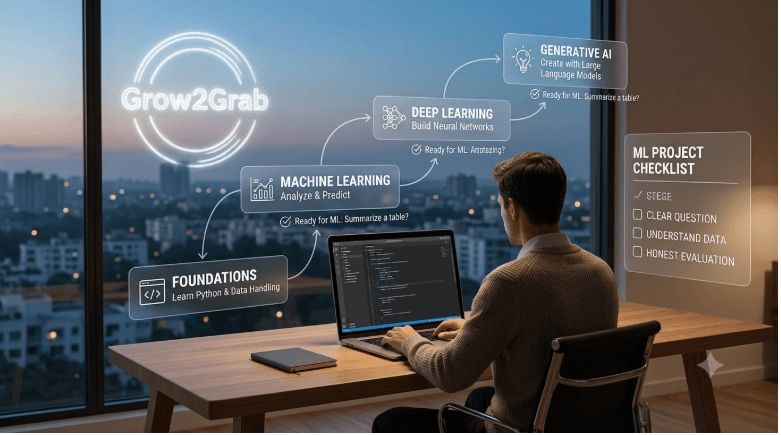
Machine learning sits inside the wider field of AI, and generative AI is built on top of machine learning, so each layer assumes the one before it. The table below turns that into checks you can run on yourself.
| Stage | What it covers | You are ready to move on when you can… |
|---|---|---|
| Programming and data foundations | Python, tables of data in Pandas, basic statistics | Load a CSV file, handle missing values and summarise the columns with a simple chart |
| Machine learning | Training models that predict from data, and judging them fairly | Split data, train a baseline model, report a metric and explain in plain words what it means |
| Deep learning | Neural networks for images, sound and language | Train a small network and recognise when it is memorising the training data |
| Generative AI applications | Building with large language models (LLMs): prompting, retrieval over your own documents, tool use | Call a model through an API, handle errors and check its answers against source text |
These are dependencies, not a fixed sequence. A marketer automating reports may need only the first and last stages. The real risk is skipping a stage you need: learners who start with LLM tooling before they can read a Python error message often struggle the first time something breaks.
Test the teaching, not just the topic list
A syllabus can name every fashionable tool and still teach little. A better test looks at three layers: concept (can you explain why a method works), implementation (can you build it yourself) and application (can you adapt it to a problem you chose). Ask how each is taught:
- Who writes the code? Compare class time spent coding with time spent watching demonstrations.
- What does a project brief contain? A good one states the problem, data, deliverable and judging criteria. “Build a chatbot” is a topic, not a brief.
- Who reviews your work, and how quickly? Feedback on your own code teaches more than a sample solution.
- Do the prerequisites match the level? Say plainly what is assumed.
- Can you explain your project aloud? A final walkthrough shows whether you understand your own choices.
Use the same questions on any provider’s page. The AI Training Institute in Punjab page at Grow2Grab, for example, describes live mentor-led sessions, batches capped at 20 and a stated 24-hour doubt-response window. Claims that are specific are easy to test in a demo class.
What a Machine Learning project should prove
A certificate says you attended. A project can show that you reason with data, if it shows more than a high score. Take an illustrative example, not a real student’s work: predicting which subscription customers will cancel. A convincing version includes:
- A clear question. Who uses the prediction, and what do they do differently? A cancellation forecast matters only if someone can act in time.
- Understanding of the data. Missing values and class balance matter. If only 5% of customers cancel, a model that always predicts “stays” is 95% accurate and useless.
- A baseline. Compare against something simple, so any improvement means something.
- Honest evaluation. Keep a test set aside for the final check and use cross-validation while tuning. The scikit-learn documentation explains that tuning against the test set lets knowledge of it leak into the model, so scores stop reflecting real performance. Use metrics that suit the problem, such as precision and recall for rare events.
- A statement of limits. Where does the model fail, and what data would it not handle?
- Clear communication, and deployment where relevant. Results should make sense to a non-specialist. Not every project is deployed, but the learner should be able to describe what serving it through an API involves.
Check whether a syllabus covers these steps. The ML Courses in Jalandhar page lists a six-module syllabus over 8–10 weeks that includes model evaluation and tuning (cross-validation, grid search, the bias–variance tradeoff) and deployment with FastAPI and Docker. In a demo, ask how projects are assessed.
Broad AI course or ML-focused course?
A broad programme introduces several areas, usually machine learning, deep learning and generative AI. It suits learners still exploring, provided each area includes hands-on work. An ML-focused course spends its time on algorithms, evaluation and deployment, and suits learners who already want predictive or data-driven work. Breadth risks shallow coverage; depth risks a narrow start. If you cannot yet describe the problem you want to solve, begin broad and insist on a project at each stage. If you can, depth is often the better fit.
To compare programmes, the AI Courses in Punjab page lists Grow2Grab’s programmes and the topics each covers. For Generative AI, read the prerequisites closely: Grow2Grab lists that course at intermediate level, recommends basic Python beforehand and says it is not a first programming course.
Making a decision in Punjab
Three questions narrow the choice faster than comparing fee lists. What can you already do, judged honestly against the table above? How many hours a week can you commit, and for how long? And what do you want to show in three months: a deployed model, a document-search assistant, a portfolio for placement season?
Format and location matter mainly where they change your access to feedback. A learner outside Jalandhar should confirm that mentor review of code works in an online batch; Grow2Grab’s pages describe in-person batches in Jalandhar and live online batches, so confirm which applies to your start date.
Also separate types of providers. A university programme such as GNDU Online’s Diploma/Certificate in AI & ML has formal eligibility rules (10+2 with minimum marks, per its page) and a semester structure covering Python, machine learning and introductory data science. A short private course is built around skills and projects, with entry rules set by the provider. Neither is better in general; the choice depends partly on whether a university credential matters to you.
Where Grow2Grab’s programmes fit
Grow2Grab Infotech is a Jalandhar company that builds AI systems for clients and also runs training. Its published programmes begin with Python and machine-learning foundations and extend to deep learning and generative AI, so they map onto the stages above. Fees, batch dates and exact durations differ between course pages, so ask for them in writing for the course you choose.
Next steps
Before enquiring anywhere, write down the stage you are at, the project you want to show in three months and the questions still open. Then compare syllabus and prerequisites, and ask about current batches, format and total fees in writing. If a Grow2Grab programme fits, use the free demo option on its course page to ask how projects are reviewed. Choose the programme that matches your stage, not the one with the longest topic list.
Real Examples
See AI projects Grow2Grab has actually built
CRM automation, YOLO models, RAG pipelines, Shopify AI tools — 9 real case studies.
Build with AI
Want AI custom-built for your business?
We design, build and deploy AI systems end-to-end — from idea to production.
Learn AI
Prefer to learn AI and build it yourself?
Practical AI courses in Jalandhar & online — ML, LLMs, agents, automation. Real projects, not theory.