Need help with AI for your business?
Grow2Grab builds custom AI solutions — automation, LLM pipelines, computer vision & more.
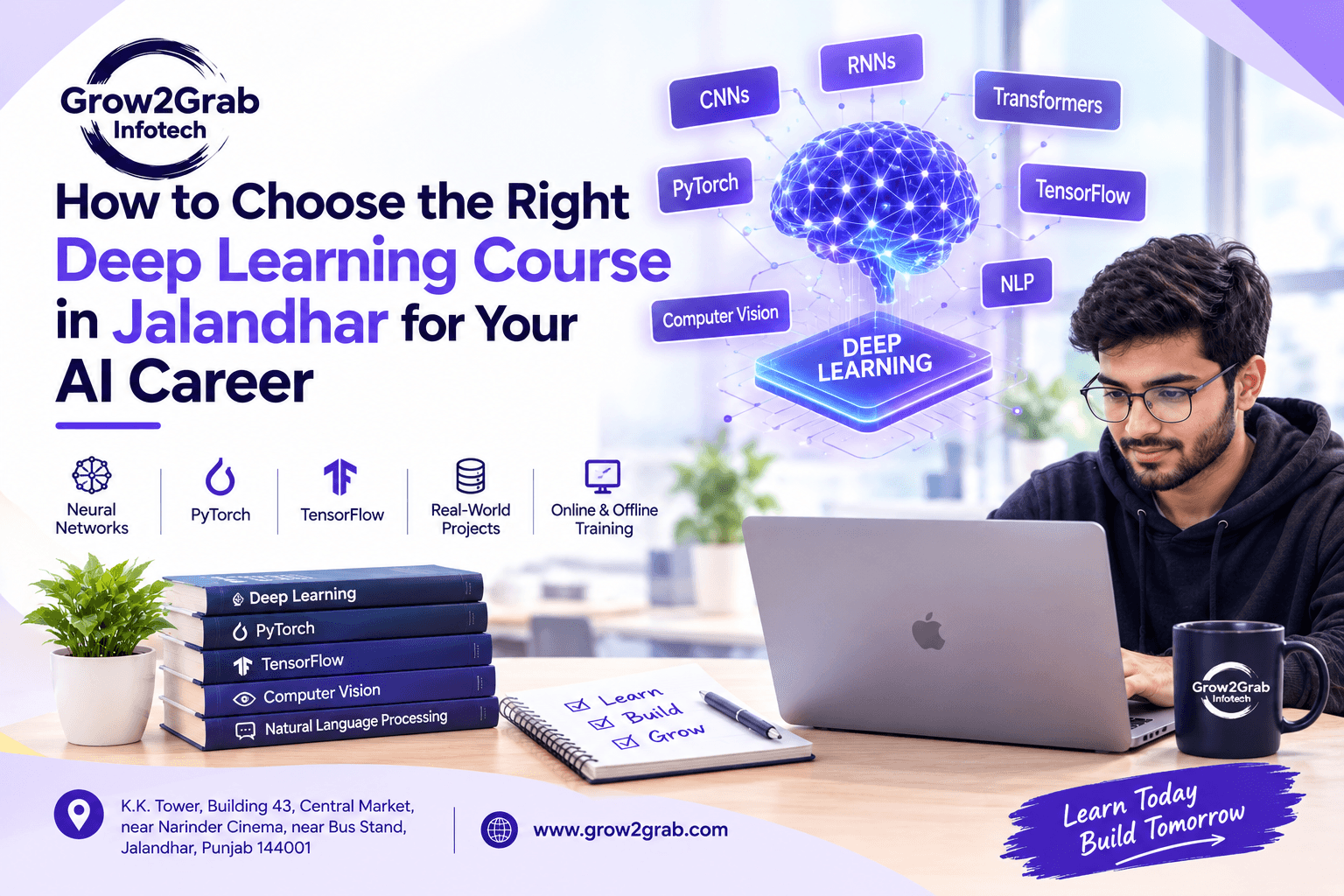
How to Choose the Right DL Course in Jalandhar for Your AI Career
Face unlock on your phone, a chatbot that replies in plain language, a camera that spots defects on a factory line: Deep Learning sits behind all of them. As more companies build AI into their products, people who understand how these systems work are getting noticed.
That is why many students and working professionals see Deep Learning as the next step in an AI career. But not every course teaches it the same way. Some stay with slides and definitions, while others make you train real models, watch them fail and fix them. If you are searching for a DL course in Jalandhar, knowing what to look for will save you time and money.
What Is Deep Learning and Why Does It Matter for an AI Career?
Deep Learning is a branch of Machine Learning that uses neural networks with many layers to learn patterns from data. Instead of writing rules by hand, you give the network thousands of examples, and it learns the rules itself.
It connects to the rest of AI in a few ways:
• Machine Learning is the wider field. Deep Learning is the part that handles complex data like images, audio and text.
• Computer Vision uses it to recognise faces, detect objects and read medical scans.
• NLP relies on it for translation, chatbots and text analysis.
• Modern AI tools, including large language models, are built on deep neural networks.
If you want to work on any of these, Deep Learning is a skill you will keep coming back to.
What Should You Look for in a Deep Learning Course?
A good course covers fundamentals first and then moves toward the tools used in real work. Here is what to check.
Practical and updated curriculum
AI changes quickly. Ask how often the syllabus is reviewed and whether it includes recent topics, not just older material.
Neural networks and fundamentals
You should understand perceptrons, backpropagation, activation functions, optimizers and techniques like dropout. Without this base, everything later feels like copy-pasting code.
CNNs and Computer Vision
Convolutional Neural Networks power image-based AI. Look for hands-on work with architectures like ResNet and tasks like object detection.
RNNs, LSTMs and sequence models
These handle time series and sequential data. Even though newer models get more attention, this section builds your understanding of how models deal with order and memory.
Transformers and attention mechanisms
Transformers sit behind most modern language models. A course that skips self-attention is leaving out a major part of today’s AI.
PyTorch and TensorFlow
You should get real practice in at least one major framework, ideally both. PyTorch is widely used in research and industry.
Real projects
Projects are where learning sticks. More on this in the next section.
Mentor support
Deep Learning is hard to learn alone. Check whether you can ask questions during and after class.
Deployment and production knowledge
Training a model is only half the job. Knowing how to serve it through an API or package it in a container makes you far more useful to a team.
Certificate and career assistance
A certificate helps, but it should not be the main reason you join. Support like resume reviews and mock interviews is a useful addition.
Why Practical Projects Matter in Deep Learning
It is easy to be impressed by a long syllabus or a fancy certificate. But employers rarely ask what you studied. They ask what you built.
Projects show that you can take a messy problem, choose a model, train it, fix errors and explain your results. A GitHub profile with two or three solid projects often says more than a list of topics.
Good beginner-to-intermediate projects include:
• Image classification, such as sorting images into categories
• Object detection, such as spotting items in a live camera feed
• Face recognition, which teaches data handling and evaluation
• Medical image analysis, which shows you can work on a serious real-world use case
• Text or sequence models built with LSTMs or transformers
Pay attention to whether the projects are guided step by step or whether you get room to experiment. The second kind teaches you much more.
How to Choose the Right Course Before You Enroll
Before you pay the fee for any DL course in Jalandhar, run through this checklist:
• Curriculum: Does it cover neural networks, CNNs, sequence models and transformers, or does it only touch the basics?
• Duration: Eight to ten weeks can work well for a focused program, but very short courses may skip important topics.
• Teaching method: Are classes live? Can you replay recordings if you miss one?
• Projects: How many will you complete, and will you own the code?
• Mentors: Ask about their background. Have they worked on AI systems, or do they only teach?
• Batch size: Smaller batches usually mean more attention for each student.
• Support: Is there a clear way to get doubts solved quickly?
• Career assistance: Does it include resume help, interview practice or referrals, and is it described honestly?
If possible, attend a demo class. Ten minutes in the room tells you more than any brochure.
Why Consider Grow2Grab for Deep Learning Training?
If you want to see how the checklist works in practice, Grow2Grab is one option to look at. It offers Deep Learning training in Jalandhar, with in-person classes at its centre near the Bus Stand and live online batches for learners elsewhere.
Based on the information on its website, the program runs for around 8 to 10 weeks and is built around live mentor-led sessions. Here is what it lists:
• Curriculum: Neural networks from scratch, CNNs and computer vision, RNNs, LSTMs and sequence models, transformers and attention, plus a capstone project.
• Tools: PyTorch as the main framework, along with TensorFlow/Keras, HuggingFace Transformers and OpenCV.
• Projects: Learners build practical projects such as real-time object detection, face recognition and medical image analysis, with GPU-based project labs.
• Deployment: Topics include FastAPI model serving, ONNX and TensorRT optimisation, and Docker with GPU cloud deployment.
• Support: Live and recorded sessions, doubt resolution, weekly office hours, a certificate with a LinkedIn badge, and placement assistance such as resume reviews and mock interviews.
As with any institute, check the latest batch details, fees and schedule directly with the team before deciding.
Is Deep Learning Suitable for Students and Beginners?
Deep Learning suits several kinds of learners:
• College students from B.Tech, BCA, MCA or related technical backgrounds who want AI skills before placements
• Working developers or data professionals who want to move toward AI roles
• Learners who already know basic Machine Learning and want to go deeper into vision and language tasks
• Students working on research or thesis projects that need hands-on model building
If you are completely new, it helps to build your base first. Learn Python properly and understand core Machine Learning ideas like training and testing data, overfitting and model evaluation. Going straight into neural networks without these can feel overwhelming. Taking a Machine Learning course first, or learning the basics on your own, is a perfectly sensible path.
How Deep Learning Can Support Your AI Career
Deep Learning does not guarantee a job, but it opens doors to several roles where these skills are valued:
• AI Engineer, building and integrating AI features into products
• Machine Learning Engineer, training, testing and deploying models
• Computer Vision Engineer, working with images, video and camera-based systems
• NLP Engineer, working on language models and text-based tools
• AI Research Assistant, supporting experiments and model development
What you can reach depends on your fundamentals, your projects and how well you explain your work. Beginners often start with internships or junior roles and grow from there.
Final Thoughts
Choosing a Deep Learning course comes down to a few honest questions. Does the curriculum go beyond theory? Will you build projects you can show? Are mentors available when you get stuck? Is there real help with the career side?
When you compare the Best AI Courses in Jalandhar, look past fees and certificates and focus on those answers. Grow2Grab is one of the places worth including in your comparison, along with any other institute you are considering.
Whichever you pick, ask for a demo class, review the syllabus line by line, and talk to the mentors. A course that matches your current level and your goals will serve your AI career far better than one that simply sounds impressive.
Real Examples
See AI projects Grow2Grab has actually built
CRM automation, YOLO models, RAG pipelines, Shopify AI tools — 9 real case studies.
Build with AI
Want AI custom-built for your business?
We design, build and deploy AI systems end-to-end — from idea to production.
Learn AI
Prefer to learn AI and build it yourself?
Practical AI courses in Jalandhar & online — ML, LLMs, agents, automation. Real projects, not theory.